
Beginner’s Mind for a New Adventure
In the beginner’s mind, there are many possibilities. In the expert’s mind, there are few.
Shunryu Suzuki, Zen Mind – Beginner’s Mind
In the Fall of 2019, I knew that something needed to change — I needed a new beginning. Through the span of multiple decades, I had built up poor psychological, physical and nutritional habits from a lifestyle far too casual. I was happy with my life, but I felt I was capable of more.
As I dug deeper into this feeling, I began to realize the importance of experience. Not only “experience” as would pertain to a job application or hobby, but the value of experience which comes from every moment we live and breathe. I reflected on how both positive and negative experiences accumulate to build a human being, and also how a negative experience doesn’t need to remain that way; that negative experience can be a building block towards a positive future. So out of this negatively accumulated state in the Fall of 2019, I made the decision to accumulate positive actions. I began to aggregate agility.
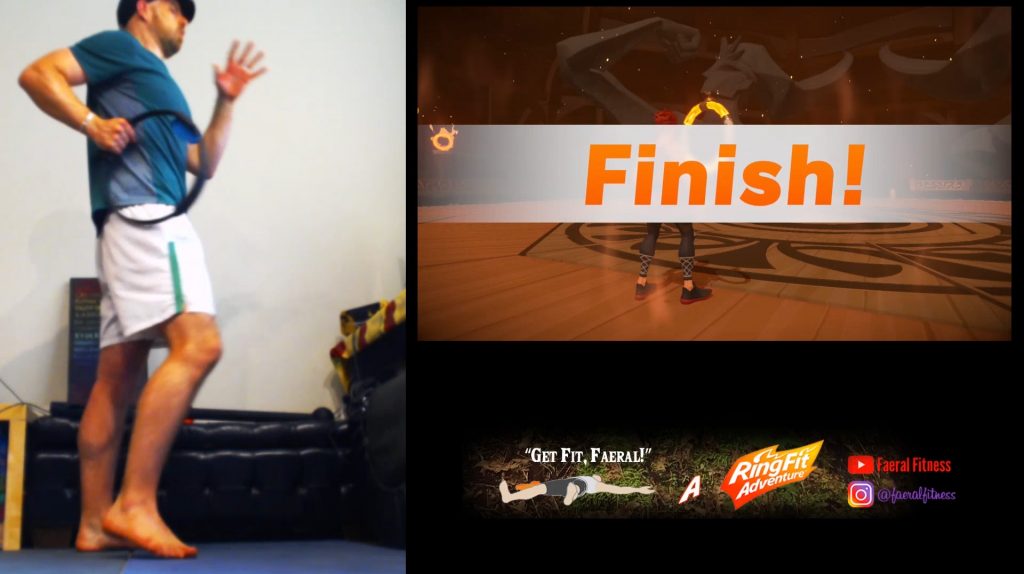
My initial vehicle for change was none other than “Ring Fit Adventure”, a fitness program available for Nintendo Switch. I have a long history with video games, and at points in my life was a massive contributing factor to the dilapidation of my physical form — yet my love of gaming has persisted. There is immense positivity which games have enriched my life with that cannot be discredited.
When my partner and I saw the initial promo for RFA, we laughed. What is this madness? Their smiles were so exaggerated and persistent, we weren’t buying what they were selling. We dismissed it as a joke at the time — but that promo planted a seed in my mind. As the release date neared, that seed started to sprout. “What if?” What if it isn’t crazy? What if a game could make an impact in our real lives? We decided to give RFA a chance.
RFA presents us with a robust set of over 70 fitness activities with which to challenge ourselves that really does place it in a class of its own. The majority of these are grouped into 4 categories: Arms, Legs, Abs, and Yoga, to provide a full body fitness program. Many of these were providing a serious challenge to my strength, balance, and coordination. I toppled while attempting Warrior III or Tree Pose, floundered when presented with Mountain Climbers, and dreaded the sheer volume of Squats on the path ahead. For those well versed in the fitness world, these were familiar motor patterns — but for me, this was a brave new world.
Andrew Huberman of The Huberman Lab recently spoke on the topic of using unfamiliar motor patterns and the making of errors to aid in adaptation of the brain. “The signal that generates the plasticity is the making of errors. It’s the reaches and failures that signal to our nervous system that “this is not working”, and therefore the shifts start to take place.” Unbeknownst to me at the time, the frustration I would experience as I fell over during Warrior III was priming my nervous system for change.
I dove in, playing RFA nearly every day. The challenges it presented me with felt gratifying because I could start to feel and see the changes taking place after just a few weeks of consistent play, and further changes as the months progressed. The Warrior III sets started to click. I completed a Perfect Mountain Climber set. I started to add more Squats to my skill rotation instead of avoiding them. I was growing stronger, and felt great about my accomplishments thus far. I began to view RFA as “True VR”, as there is a more tangible connection between my body and the game beyond just a visual VR interface; I used my body to play the game, and in turn, the game was helping to change my body.
The variety of skills RFA presents is key to longevity of the platform. Since it is the making of errors that provides our nervous system with the signal for change, in order to continue learning, I would need to continue to make errors. As I gained confidence in certain skills, it was time to return to the beginning again by exploring new movement concepts. Huberman goes on to say, “If you’re good at handstands, guess how much plasticity doing handstands for half an hour is going to create for you? Zero.”
Ido Portal speaks to this in “Just Move”: “The problem is the more you play the game, the less it does the magic. And at the same time, the more you play the game, the better you become at it. They move in inverse correlation. The more you do it, the more you like to do it, but the less it is for you. Because now it becomes a specialized tool.”
These “specialized tools” would still play an integral role in the development of my strength and mobility capacity, but my rate of errors diminishes with practice as my confidence increases. This is reflected also in the Principle of Diminishing Returns: “As an athlete nears their genetic potential, the gains in performance will be much harder to obtain. The key is to continue to show progress in the areas in which they have weaknesses.” – NSCA Basics of Strength and Conditioning
So, to recognize weakness in myself is to identify potential for growth. RFA set me up to succeed by making me fall down, and it opened my eyes to a pathway towards a passion of mine always burning in the back of my mind — Freestyle Footbag. If I can find positive growth through the errors involved in a set of seventy movements in RFA, what can I accomplish by tackling the errors presented by hundreds, if not thousands, of movement combinations in the sport of Footbag?
It is time to return to the beginning once again.

Aggregate Agility is founded on the belief that who we become is forged by the aggregate of our experiences. The articles I post here are to pay homage to the educators and knowledge seekers that have provided valuable insight on my journey ( n = 1 ).


Research your own experience. Absorb what is useful, reject what is useless, add what is essentially your own.
Bruce Lee